
If you’ve tried probiotics and felt nothing, you’re not doing it wrong.
That’s worth saying plainly, because when something doesn’t work, the natural assumption is that you picked the wrong brand, didn’t take enough, or gave up too soon. More often, the issue is something else entirely.
Probiotics aren’t failing because they’re weak. They’re failing because the gut environment they’re entering isn’t ready for them.
— — —
The part that usually gets skipped
Most people treat probiotics the way they treat a medication. There’s a problem, so you take the pill, and the pill addresses the problem.
But probiotics aren’t drugs. They’re living organisms. And living organisms respond to conditions.
A capsule full of beneficial bacteria doesn’t override what’s happening in your gut. It arrives there — and has to survive it.
If digestion is sluggish, stress is high, sleep is poor, and fiber intake is low, new microbes show up with nowhere to settle and nothing to eat. They don’t thrive. They don’t stay. And sometimes they make enough noise on the way through that you wonder whether they’re making things worse.
For some people, temporarily, they are. That’s not a sign your gut is broken. It’s a sign the conditions weren’t ready.
— — —
What the gut actually needs first
Your gut works more like a garden than a container.
You can plant the best seeds in the world. But if the soil is depleted — no water, no nutrients, no consistency — nothing much grows. The same is true for beneficial bacteria.
So what prepares the soil?
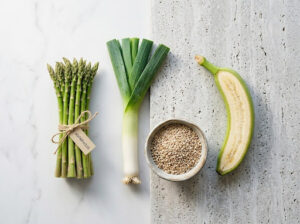
Fiber. Beneficial bacteria need it to survive. Vegetables, legumes, whole grains, seeds — regular variety here matters more than any single food. Without enough fiber, you’re asking microbes to live somewhere with nothing to eat.
Steadier stress. Chronic stress can slow digestion, speed it up, or make it unpredictable — and probiotics can’t fix that on their own. The goal isn’t zero stress, it’s more consistent inputs: regular meals, gentle movement, fewer food rules. When the gut gets steadier conditions, it tends to settle.
Sleep. Your gut does a lot of its maintenance work overnight. The lining repairs. Inflammation quiets. Beneficial bacteria follow a daily rhythm, and sleep is part of what keeps that rhythm steady. No supplement replaces this — and probiotics in particular tend to struggle when sleep is regularly poor.
Consistency. Here’s something that surprises a lot of people: overhauling everything at once tends not to work as well as changing one or two small things and repeating them. The gut responds to patterns over time, not to big pushes. Less pressure, more repetition — and over time, better results.
— — —
Where probiotics do fit in
None of this is an argument against using probiotics. They can help. Timing just matters.
They tend to work best after the foundations are in place — when fiber intake is more consistent, stress is calmer, and sleep is steadier. At that point, adding beneficial microbes gives them something to work with.
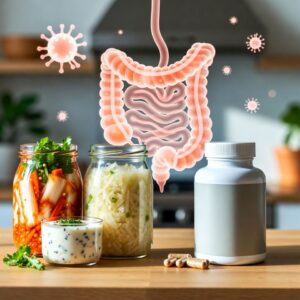
Many people also find fermented foods feel gentler than capsules, at least as a starting point. Yogurt, kefir, sauerkraut, kimchi — these arrive with context already built in. The microbes come alongside the nutrients that support them.
That doesn’t mean capsules aren’t worth using. It just means the order matters. Prepare the environment first. Then add.
— — —
A simpler way to think about all of this
If probiotics haven’t helped you, the takeaway isn’t to give up on them.
It’s this: you may not need more bacteria. You may need a better environment for the bacteria to land in.
The gut responds to what you give it consistently over time. When those steady inputs are in place — regular fiber, calmer stress, reliable sleep, consistent meals — a lot of things start working better. Including, eventually, the probiotics.
The approach that tends to work isn’t dramatic. It’s a system you can repeat.
— — —
One place to start
If there’s a single low-pressure first step here, it’s feeding your microbes more consistently.
That means finding the practical fiber sources you can add gradually, without the bloating that makes most people stop. I put together a simple Prebiotic Shopping List that shows you which everyday foods do this most reliably. No complicated prep, no expensive ingredients.
Download the free Prebiotic Shopping List here
Next time, we’ll go deeper on prebiotics and fiber — what they actually are, why they often matter more than the probiotic conversation, and how to increase them in a way your gut can handle.
That’s where a lot of people start to notice a real difference.
Talk soon,
—Reid
reidashford.com