
Probiotics and fermented foods get a great deal of attention in gut-health conversations.
Some people treat them like a cure-all. Others try one yogurt or one supplement, notice no obvious difference, and conclude the whole topic must be overhyped.
The truth is usually more useful than either extreme.
Probiotics and fermented foods can play a meaningful role in gut health. But they are not magic, and they are not the whole story. Their value depends on what you are using, how consistently you use it, how your gut responds, and the broader environment you give your gut each day.
This guide will help you think more clearly about the topic — what probiotics are, where fermented foods fit, how the two differ, and how to use them in a practical, steady, and realistic way.
If you want the short version first, start here.
No. They overlap, but they are not the same. Probiotic supplements are usually targeted products built around specific strains. Fermented foods are foods first, and some contain live microbes when you eat them.
Download the free Fermented Foods Starter Guide for a practical introduction to choosing live-culture foods, starting slowly, and using them well.

Probiotics are live microorganisms that, when consumed in adequate amounts, may provide a health benefit.
Before going further, it helps to understand why microbes matter at all.
Your digestive tract is home to trillions of microbes that help break down parts of food, produce useful compounds, interact with your immune system, and shape the overall environment of the gut. When people talk about supporting the gut microbiome, they mean supporting this living internal ecosystem.
That definition sounds simple, but it hides an important truth: not all probiotics are the same.
Different strains can behave differently. Different products can vary in quality. And people can respond very differently depending on their gut environment.
That matters because many people talk about probiotics as though they were one thing.
They are not.
Fermented foods are foods that have been transformed by beneficial microbes.
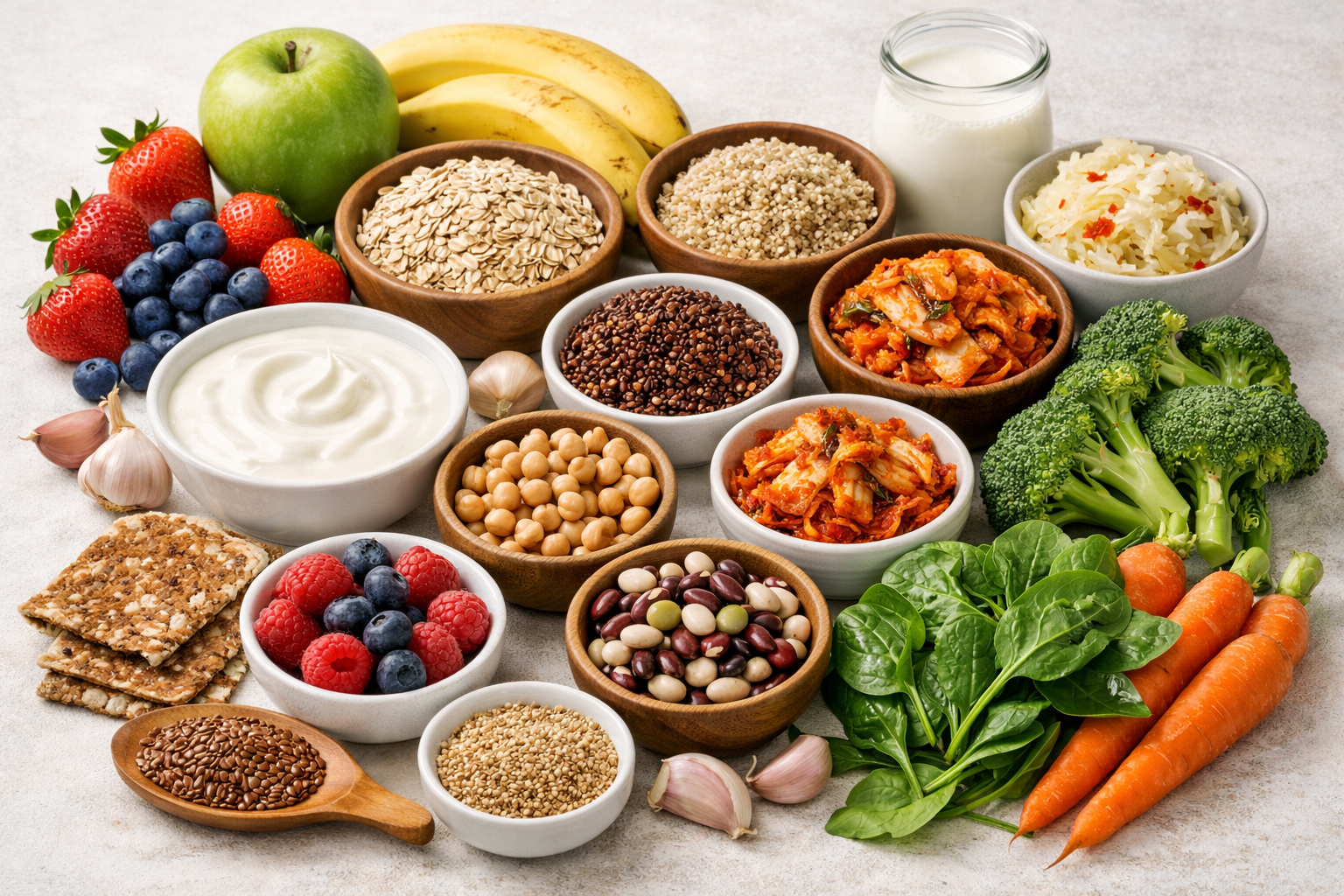
Examples include yogurt with live cultures, kefir, sauerkraut, kimchi, miso, tempeh, and fermented vegetables.
Some fermented foods contain live cultures when you eat them. Others do not, especially if they have been heat-treated after fermentation. That is one reason labels and preparation methods matter more than many people realize.
Fermented foods can be valuable not only for their microbes but also because they make gut support more practical. They are foods you can build into meals, repeat regularly, and turn into steady habits.
That matters because gut health is rarely improved by one dramatic decision. It is usually shaped by what you do regularly.
This is where many people get tripped up.
A supplement may be chosen because it contains strains that have been studied for a particular use. A fermented food may offer live microbes, too, but it also brings along its own food matrix, flavors, acids, textures, and meal-building possibilities.
Neither category is automatically better in every situation. But they are not interchangeable.
Usually more targeted, more product-specific, and more dependent on strain selection.
Usually, more food-first, easier to build into meals, and often better suited to daily routines.
When someone says, “I tried probiotics, and they didn’t work,” the next question is often: What kind did you try, and in what context?
Not necessarily.
A food may be fermented and still not deliver meaningful live microbes by the time you eat it. Some products are heat-treated after fermentation. Others may be shelf-stable, in a way that no longer preserves much of their living activity.
So it helps to separate the three ideas:
This is why reading labels, noticing where a product is stored, and keeping expectations realistic all matter.
Simple rule: if a fermented food has been heavily processed or heated after fermentation, its live microbial content may be reduced or lost.
Probiotics and fermented foods may help support:
Support is the right word here.
Not fix. Not cure. Not solve everything.
Your gut is an ecosystem, not a switch. If the rest of that ecosystem is under-supported — low fiber intake, highly irregular eating, poor sleep, chronic stress, low hydration, or a pattern of constantly changing strategies — then probiotics or fermented foods may have less to work with.
This is one reason I encourage people to think in systems, not shortcuts.
Two people can take the same probiotic or eat the same fermented food and have very different experiences.
That does not necessarily mean one of them is imagining it, or that the food works for one person and fails for the other in some universal way.
Usually, the context is different.
Your response can be shaped by:
That is why a calmer, more observational approach tends to work better than an all-or-nothing one.
Some are. Some are not. Heat, processing, and storage matter.
A large serving is not always a better serving. Many people do better when they start small and stay steady.
Sometimes the effect is subtle. Sometimes the benefit comes from consistency over time, not from one dramatic moment.
Fermented foods can be useful because they are part of meals, routines, and repeatable habits — not just because of what is happening at the microscopic level.
If you change breakfast, add a supplement, start kimchi, increase fiber, and begin a new sleep routine all in the same week, it becomes much harder to tell what is helping.
If you are curious about fermented foods, start simply.
Choose one beginner-friendly option such as:
Start with a small amount.
For many people, that means:
Stay with it long enough to notice how it fits your digestion and your routine.
And whenever possible, pair fermented foods with fiber-rich foods rather than thinking of them as a standalone fix.
A meal with yogurt, berries, and oats, or a bowl with vegetables, grains, and a small serving of kimchi, often makes more practical sense than chasing a perfect probiotic strategy in isolation.
A slower approach often makes sense for:
Starting small is not a sign that you are doing it wrong.
Often, it is the smarter way to learn what your gut actually tolerates.
This is where many people find relief.
You do not need probiotics or fermented foods to carry the entire burden of gut health.
They can be helpful tools. They can be part of the picture. They can become valuable allies in a food-first routine.
But they work best alongside the basics that give your gut a better environment in the first place:
That may sound less exciting than bold promises on a supplement label.
But it is usually much more helpful.
The Gut Health Beyond Basics Course helps you build a practical, personal system for supporting your gut through food, habits, and daily rhythms.
If you want to go deeper, these are good next reads:

Curious about homemade ferments?
The Fermentation Primer offers a deeper introduction for readers who want to explore fermentation at home.
Probiotics and fermented foods deserve attention, but they deserve clear thinking too.
They are not nonsense. They are not magic. They are not interchangeable. And they are not equally useful in every form, for every person, in every moment.
What they can be is practical.
They can help you build more daily contact with living foods. They can support microbial variety. They can fit into meals you already enjoy. And they can become one part of a broader gut-supportive system you can actually live with.
That is where they tend to become most valuable.