
If you have ever tried to “eat more fiber” and ended up feeling more bloated, gassy, or uncomfortable, you are not alone. Prebiotics and fiber can do a great deal of good for the gut – but how you introduce them matters.
This guide will help you understand what prebiotics and fiber actually do, why they matter, and how to increase them in a calmer, more practical way.
Prebiotics are compounds in food that help feed beneficial microbes in your gut. In plain English, they are part of what nourishes the helpful bacteria already living there.
That matters because your gut microbes do not just sit quietly in the background. They help break down parts of food, produce useful compounds, and influence things like digestion, regularity, and the overall environment inside the gut.
When people hear the word “gut health,” they often think immediately of probiotics. But probiotics are only part of the picture. If beneficial microbes are going to stick around and do useful work, they need nourishment too.
That is where prebiotics come in.

One of the simplest ways to understand prebiotics is to picture your gut as a living ecosystem.
The beneficial microbes in that ecosystem need the right kind of nourishment to thrive. Prebiotic foods help provide that nourishment. When you regularly eat foods that feed those microbes, you are not just eating for yourself – you are also helping support the microbial community that lives with you.
That does not mean every prebiotic food will feel good right away. Sensitive guts often need a slower, gentler approach. But the basic idea is still important: if you want a stronger, more resilient gut environment, feeding beneficial microbes matters.
Fiber is one of the most talked-about parts of gut health, and one of the most misunderstood.
Most people know fiber is supposed to be “good for you,” but that advice can feel frustratingly incomplete when eating more fiber seems to make digestion worse instead of better.
The problem usually is not that fiber is bad. The problem is often that the gut needs time, context, and the right form.
Fiber can help support regular bowel movements, add bulk or softness where needed, and support a healthier gut environment. Some types of fiber also act as prebiotics, meaning they help feed beneficial microbes.
In real life, that can translate into better regularity, more stable digestion, and better long-term gut support.
But “more” is not always “better,” especially at first.
A sudden increase in fiber intake can cause real discomfort. Gas, bloating, pressure, cramping, and changes in stool are common when someone goes from low fiber to high fiber too quickly.
This is one reason broad advice like “just eat more fiber” often falls flat.
For sensitive guts, the goal is not to force as much fiber as possible, as quickly as possible. The goal is to build tolerance gradually and pay attention to how your body responds.
A calmer approach usually works better than an aggressive one.
If your gut tends to react quickly, the best approach is usually calm and gradual.
This is not about forcing progress. It is about helping your system adapt.
You do not need to become an expert in fiber chemistry, but a basic understanding of soluble and insoluble fiber can be helpful – especially if your digestion is sensitive.
Soluble fiber absorbs water, forming a softer, gel-like texture. In many cases, it feels gentler and more soothing for sensitive digestion.
Foods with soluble fiber can help support stool consistency and may be easier to tolerate as someone gradually builds fiber intake.
Insoluble fiber tends to add bulk and move through the digestive tract more directly. That can be helpful for some people, but it can also feel rougher or more irritating for others, especially when eaten in large amounts or introduced too quickly.
That does not make it “bad.” It simply means tolerance varies.
Texture can make a bigger difference than many people realize.
Cooked vegetables are often easier to tolerate than raw ones. Softer foods may feel gentler than crunchy, coarse, or highly fibrous ones. Blended soups, cooked oats, ripe bananas, and softer starches may go over better than large salads, raw cruciferous vegetables, or dense bran-heavy foods.
Sometimes the issue is not just the food itself. It is the form, the quantity, and the speed of change.
If your gut tends to react quickly, the best approach is usually calm and gradual.
This is not about forcing progress. It is about helping your system adapt.
A simple starting point is to add one gentle fiber-rich or prebiotic food at a time, in a modest amount, and stay there long enough to see how your gut responds.
That may mean choosing one change for several days before adding another. For some people, a gradual ramp of 7 to 14 days works much better than trying to overhaul everything at once.
The exact pace does not need to be perfect. What matters is giving your gut a fair chance to adjust.
Adding too much too fast. This is the biggest one. A large jump in fiber often creates discomfort, making people feel like they are “failing” fiber, when really they just moved too quickly.
Fix: pull back to a smaller amount and increase more gradually.
Fix: begin with gentler options like oats, ripe bananas, cooked vegetables, or small portions of cooked and cooled starches.
Making too many changes at once. When you change breakfast, lunch, snacks, supplements, and hydration all at the same time, it becomes hard to tell what is helping and what is not.
Fix: change one or two things first, then build from there.
If your gut feels noticeably more bloated, crampy, or unsettled, it may help to pause where you are rather than keep increasing.
That does not mean you have failed. It often means your system needs a little longer to catch up.
Stabilizing at a tolerable level is often smarter than pushing forward and making yourself miserable. Consistency usually helps the gut more than forcing progress ever could.
If your gut tends to react quickly, the best approach is usually calm and gradual.
This is not about forcing progress. It is about helping your system adapt.
Prebiotic foods come from a variety of categories. Some are easier to tolerate than others, especially at first.
Here are a few practical categories to know.
Oats are often one of the gentler starting points. They are practical, familiar, and easy to prepare in a softer form.
Gentle starter: cooked oatmeal.
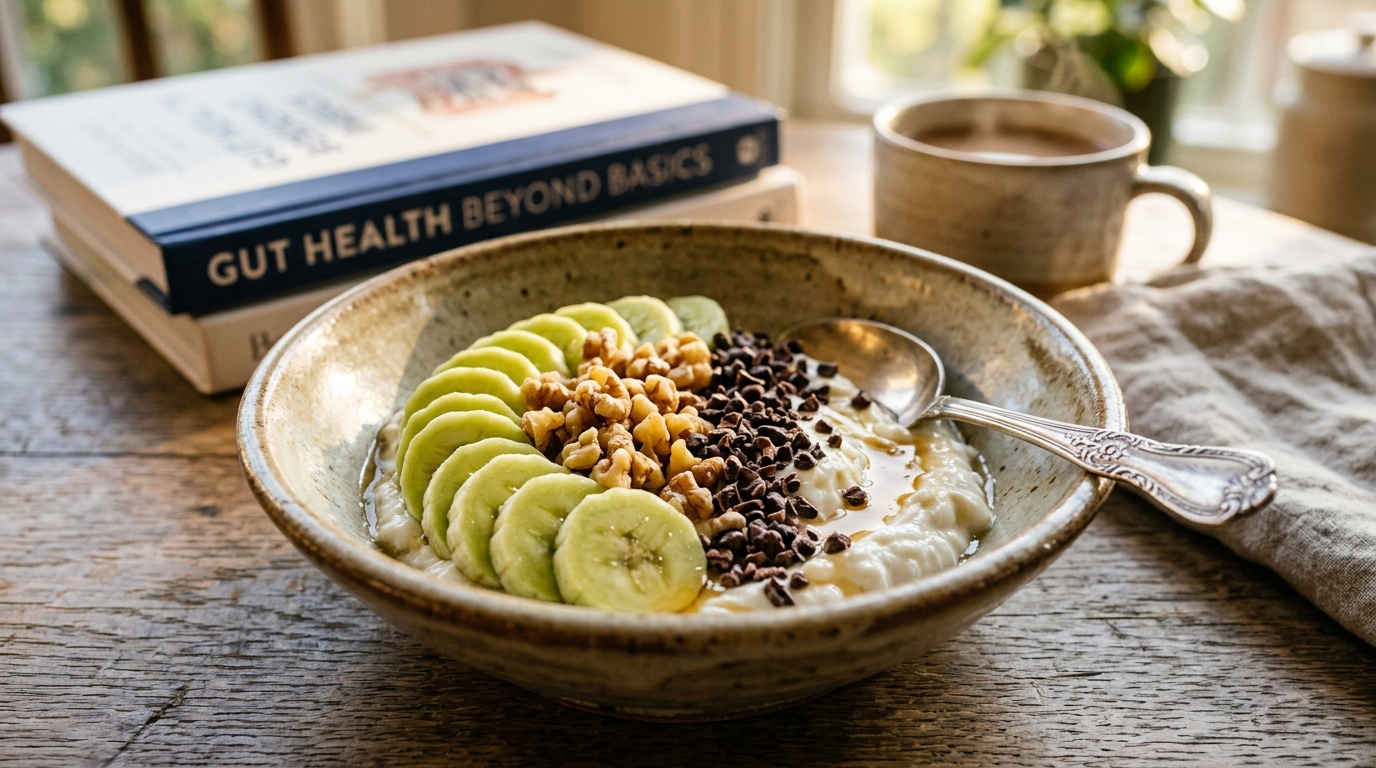
Bananas can be a practical option, especially when introduced thoughtfully. Ripeness can affect how they feel for different people. Slightly green bananas have a greater prebiotic effect, while riper ones are a little easier on your system.
Gentle starter: a small portion of banana with breakfast.
Beans, lentils, and chickpeas can provide valuable fiber and prebiotic support, but they can also be challenging in larger portions.
Gentle starter: small portions of well-cooked lentils or chickpeas.
Garlic, onions, leeks, and similar foods are well-known for their prebiotic potential, but they can also be strong triggers for some sensitive people.
Gentle starter: small amounts used in cooked meals, if tolerated.
Cooked and cooled potatoes, rice, and similar starches can provide resistant starch, which can help support beneficial microbes.
Gentle starter: a modest portion of cooked and cooled potatoes or rice added to a meal.
Other foods may also provide useful fiber or prebiotic support, depending on the person and the meal pattern.
The goal is not to eat every possible prebiotic food. The goal is to find the ones your gut handles best, then build from there.
The word “synbiotic” sounds technical, but the idea is simple.
A synbiotic meal or snack combines foods that help add beneficial microbes with foods that help feed them.
Breakfast: plain yogurt with oats and sliced banana.
Lunch: a grain bowl with cooked and cooled potatoes and a side of cultured yogurt or kefir.
Dinner: a simple meal with cooked vegetables, legumes if tolerated, and a fermented side.
Snack: kefir with a small serving of oats or banana.
The point is not perfection. The point is to make these pairings feel practical in everyday life.
In practical terms, it means pairing a probiotic food – such as yogurt, kefir, or certain fermented foods – with a prebiotic-rich food that helps nourish beneficial microbes.
You do not need to make this complicated. A few thoughtful pairings can go a long way.
This often happens when fiber or prebiotic foods are increased too quickly.
Try reducing the amount, choosing softer or cooked forms, and giving your gut a few more days at the same level before increasing again.
Sometimes the issue is not just low fiber, but the overall pattern of meals, hydration, movement, or food variety.
A gentler increase in fiber-rich foods, especially in tolerable forms, may help support better regularity over time.
If stools become looser, it may help to scale back the amount or type of fiber being added and return to foods that feel steadier and easier to tolerate.
Again, slower is often better.
This is a common experience, and it does not necessarily mean your gut cannot improve.
Sometimes the issue is not that all gut-supportive strategies are wrong for you. Sometimes it means the dose, form, timing, or overall context needs to change.
For many people, beginning with food-based approaches and building gradually feels better than forcing a probiotic supplement that clearly is not sitting well.
If you want a simpler way to put this into practice, start with the Prebiotic Shopping List + Synbiotic Pairings.
It will help you identify practical foods, gentler starting points, and easy combinations you can use in real life.
If you want the fuller system for building meals, habits, and gut-supportive routines that are easier to live with, you can also explore the book and course for more step-by-step guidance.
If you want to go deeper, these are good next reads:

If your gut tends to react quickly, the best approach is usually calm and gradual.
This is not about forcing progress. It is about helping your system adapt.